
A Stark Warning From Government and New Data

The UK government has publicly acknowledged what workers, economists, and industry analysts have been discussing for months: AI will cost UK jobs. In one of the most direct statements yet from a senior minister, Technology Secretary Liz Kendall admitted that artificial intelligence will lead to job losses across multiple sectors — especially among early‑career white‑collar workers.
At the same time, new research shared with The Guardian reveals that the UK is being hit harder by AI‑driven workforce disruption than any other major economy including the US, Japan, Germany and Australia.
“I want to level with the public. Some jobs will go.”
— Liz Kendall, UK Technology Secretary
AI Is Reshaping the UK Labour Market — Fast

According to analysis cited by The Guardian, British companies report that AI has caused net job losses of 8% over the past year — the highest among the G7 peers surveyed. AI‑enabled productivity gains (averaging 11.5%) have not translated into job creation at the same rate as in the US. This means the UK is losing more jobs to AI than it is creating.
Early‑career roles — particularly graduate entry positions in law, finance, accountancy, consulting, transport, and professional services — are most exposed. “White‑collar vulnerability” is emerging as a central theme of the UK’s AI transition.
London mayor Sadiq Khan has warned that without intervention, AI risks becoming a “weapon of mass destruction of jobs,” especially in London’s finance‑centric economy.
What the Government Is Doing About It
Liz Kendall announced an unprecedented plan to train 10 million British workers in basic AI skills by 2030, describing it as the largest upskilling programme since the creation of the Open University. The initiative covers a wide range of workers — including civil servants, public‑sector staff, and senior leaders.
- A new “Future of Work Unit” will oversee workforce transition.
- Major partnerships include organisations such as Multiverse and global AI companies.
- The UK aims to become the fastest adopter of AI in the G7.
- New AI tools will be built to support public services, including job‑search tools on gov.uk.
The strategy recognises that while AI creates new opportunities, these benefits won’t be evenly distributed or easily accessed without large‑scale intervention.
Why the UK Is Being Hit Harder Than Other Countries
The Guardian’s reporting offers several explanations for why AI disruption appears sharper in the UK:
- High reliance on white‑collar jobs in finance, legal services, and consulting.
- Rising labour costs (minimum wage increases and employer NI contributions).
- Slower job creation relative to productivity gains compared with the US.
- Higher economic fragility following years of slow growth.
Public Sentiment: Anxiety Is Rising
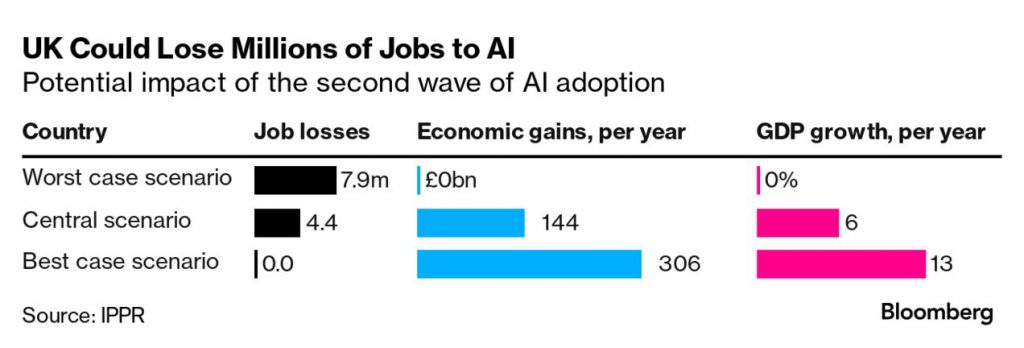
More than one‑quarter of UK workers fear their job may disappear within five years due to AI — a higher level of fear than in almost any comparable economy. Gen Z workers are most anxious about their ability to adapt, while older workers show higher levels of confidence.
This tracks with global data showing that the UK workforce feels less prepared than peers in the US and Europe, making job displacement concerns sharper and more widespread.
What Happens Next?
AI will not make all jobs vanish, but it will reshape the labour market faster than any previous automation wave. The UK government’s transparency marks a shift toward realism — acknowledging disruption while preparing a national response.
The next five years are likely to include:
- Disruption in legal, finance, and transport sectors.
- Rapid growth in AI‑related and hybrid roles.
- An urgent need for digital reskilling across all age groups.
- Potential widening of inequality if training efforts fall short.
The UK is standing at the sharpest edge of global AI change. The choices made now — around training, regulation, and investment — will determine whether the country thrives or struggles through the transition.